Communities living near coasts are increasingly at risk from coastal flooding as climate change raises sea-levels and causes storms to occur more frequently. Mangrove forests can help protect communities from this threat, as they reduce the energy of waves and storm surges, and trap sediment to help coasts keep pace with rising sea levels. But realizing this potential is challenging.
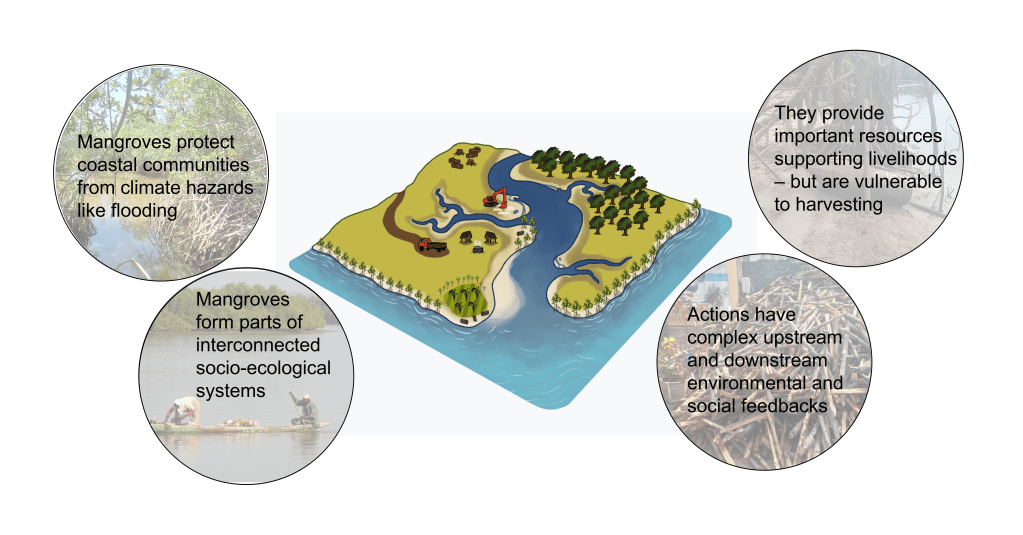
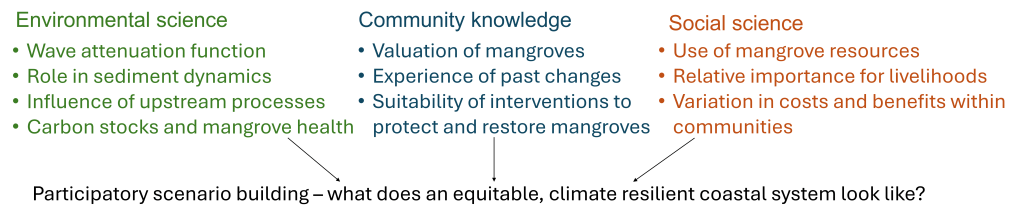
Tackling this complexity requires bringing together different types of knowledge. In Co_WAM, we will build on the knowledge communities have of mangroves, their changes and their relationship with people, and work with communities to imagine different ways of living with mangroves.
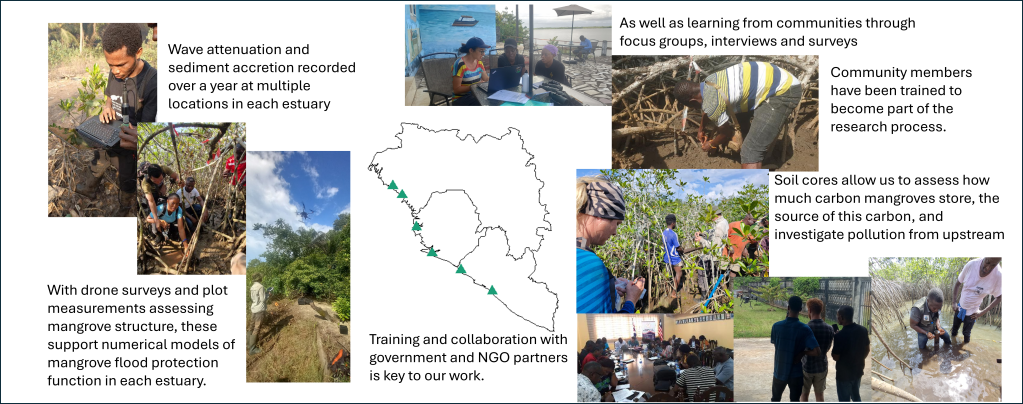
We will then collect the evidence needed to evaluate these different scenarios. This includes making measurements and models of how different mangrove landscapes protect communities from flooding, looking at how sensitive this protection is to processes such as mining or forest loss along the rivers upstream of the mangroves, and seeing whether different strategies to protect mangroves affect some people more than others.
Finally, we will examine these results with communities, refining scenarios and models to arrive at co-designed solutions.
We are working in different estuaries in Guinea, Liberia and Sierra Leone to understand how environmental and socio-political contexts influence the coastal protection function of mangroves, communities’ dependence on mangrove resources, and the success of different strategies to protect and restore mangroves.
 Co-WAM